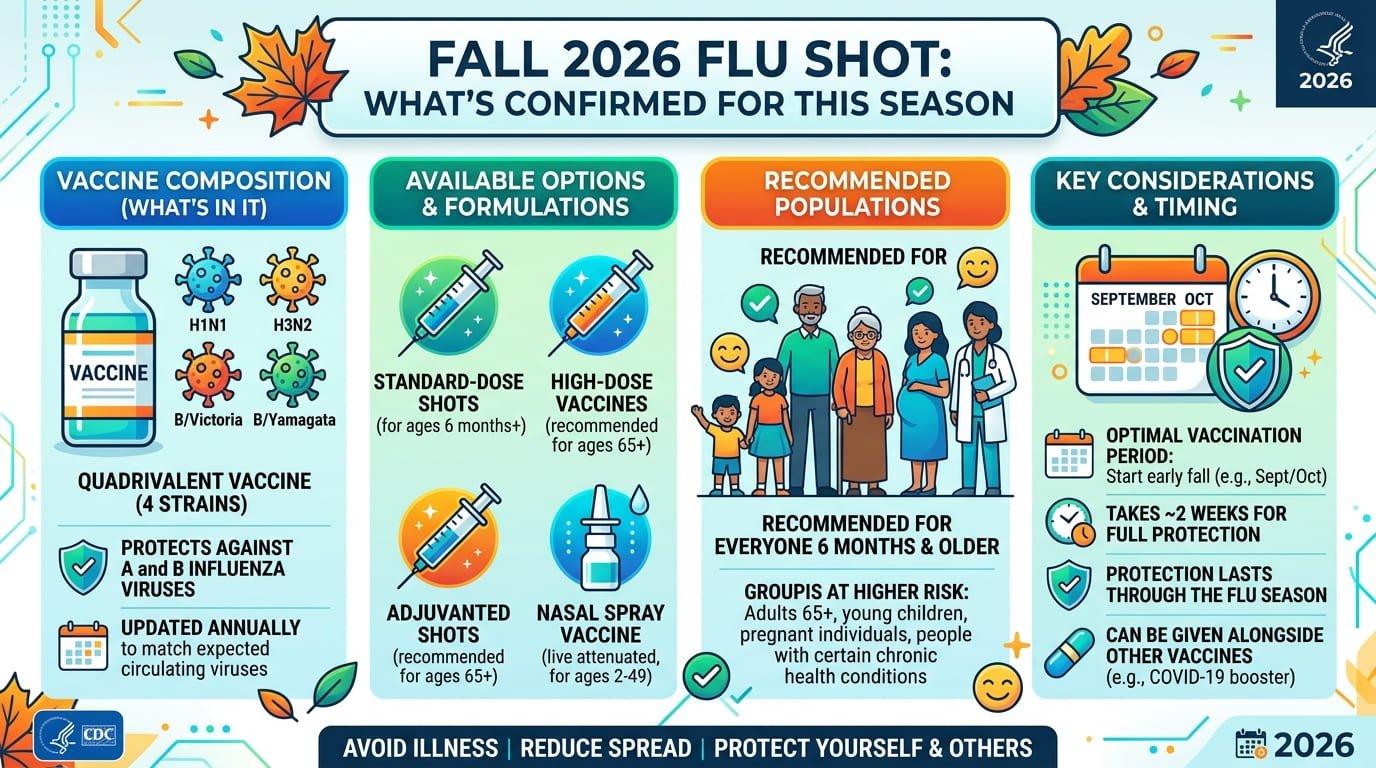
Flu shots are back at pharmacies across the United States and Canada, but this fall feels different. Several major medical groups released their own vaccine recommendations separately from the government’s, leaving many people unsure who to listen to. Here’s what’s actually confirmed for the 2026-2027 respiratory virus season.
Why This Fall’s Vaccine Guidance Looks Different
Every year, U.S. health officials update flu, COVID-19, and RSV vaccine recommendations ahead of the fall and winter respiratory season. This year, the Centers for Disease Control and Prevention (CDC) said the flu vaccination guidance from its July 2025 immunization schedule would simply carry over into 2026-2027, citing ongoing legal and procedural questions.
Because that update didn’t address newer products, including the first mRNA flu vaccine the FDA approved for older adults, several medical groups stepped in. The American Academy of Pediatrics, the American Academy of Family Physicians, and the American College of Obstetricians and Gynecologists published their own 2026-2027 recommendations after reviewing independent evidence analyses from the American Medical Association and the University of Minnesota’s Vaccine Integrity Project.
The result is two overlapping sets of guidance this fall. It’s confusing, but the underlying medical consensus about who benefits most from vaccination hasn’t shifted much.
What’s Confirmed About the Flu Vaccine This Year
The CDC continues to recommend annual flu vaccination for everyone six months and older without a medical reason to avoid it. All three virus strains in this season’s vaccines were updated, including a change targeting an influenza A(H3N2) subclade that spread widely last winter.
Key points for the 2026-2027 flu vaccine:
- September or October is generally the best time to get vaccinated, though shots remain useful throughout the season.
- Adults 65 and older are encouraged to get a high-dose, adjuvanted, or recombinant vaccine when one is available.
- People with egg allergies can safely receive any age-appropriate flu vaccine.
- Flu shots can be given alongside COVID-19 and other vaccines.
COVID-19 Vaccines: More of a Personal Decision
COVID-19 guidance has shifted toward individualized decisions made with a healthcare provider rather than a blanket recommendation for everyone. The benefit is clearest for people at higher risk of severe illness, including older adults, pregnant people, and those with certain chronic conditions.
In Canada, the National Advisory Committee on Immunization (NACI) takes a similar risk-based approach but has gone further for some groups, now recommending that adults ages 65 to 79 with underlying medical conditions may receive a second COVID-19 dose within the same year. Coverage varies by province, and some, including Quebec, have scaled back free flu shots for the general public this season, so Canadian readers should check what their province currently offers.
RSV: A Smaller, More Targeted Recommendation
Unlike flu and COVID-19 vaccines, RSV immunization has never been recommended for everyone. It’s targeted mainly at adults 75 and older, adults 60 to 74 with certain health conditions, infants, and pregnant people during a specific window, since these groups face the highest risk of severe illness. RSV activity typically increases later in the fall, so there’s generally no rush to get this one immediately.
What Readers Should Know
Even with the guidance gap, a few things remain broadly agreed on by mainstream medical groups on both sides of the border:
- Annual flu vaccination is still recommended for nearly everyone six months and older.
- People at higher risk from flu, COVID-19, or RSV, including older adults, pregnant people, and those with chronic conditions, see the clearest benefit from vaccination.
- Vaccines can typically be given at the same visit, though your provider can advise on spacing.
- Full protection takes about two weeks to build, which matters if you’re planning travel or a large gathering.
This is general information, not a personal recommendation. Your own health history and risk factors should guide your decision, ideally in conversation with a provider or pharmacist.
When to Talk to a Healthcare Professional
Check in with a doctor, nurse practitioner, or pharmacist before vaccination season if you’re pregnant or breastfeeding, have a weakened immune system, have a history of severe vaccine reactions, or care for a young infant or an elderly family member. They can also help with timing if you’re recovering from a recent illness or getting several vaccines close together.
Conclusion
This fall’s vaccine season has more moving pieces than usual, with federal guidance, medical societies, and provincial or state health departments not always aligned. But the core message from mainstream medicine hasn’t shifted: flu vaccination remains broadly recommended, COVID-19 and RSV vaccines matter most for those at higher risk, and a quick conversation with a healthcare provider is the simplest way to cut through the noise.
Frequently Asked Questions
Is it too early to get a flu shot in September?
No. Health officials generally consider September and October the ideal window, since protection can take about two weeks to build and typically lasts through the winter months when flu activity peaks.
Can I get my flu shot and COVID-19 vaccine on the same day?
Yes. Health authorities in both the U.S. and Canada note that flu and COVID-19 vaccines, along with most other vaccines, can be given during the same visit.
Why do U.S. and Canadian vaccine recommendations look different this year?
The two countries’ health agencies review evidence independently, and several U.S. medical societies also issued their own recommendations after the CDC’s update didn’t address newer flu vaccine products. That’s created more visible differences than usual, though guidance for high-risk groups remains similar.
This article is for general educational purposes only and is not a substitute for professional medical advice, diagnosis, or treatment. Vaccine recommendations can vary by age, health history, and location. Always consult a qualified healthcare provider or your local public health authority before making vaccination decisions for yourself or your family.